You're Not Wrong — You're Just Early: A Salary Reality Check for Canadian Grads

You've spent years grinding through exams, surviving group projects, and building your professional identity. You've done the math on your dream apartment. You have a number in your head: maybe $65,000, maybe more. You think it feels fair. It feels earned.
But here's the thing no one brought up to you at orientation: what you expect to earn your first year out of school and what you're likely to actually earn are often two different numbers. Not because you're being unrealistic. Not because you're not qualified. But because there's a gap between student expectations and market reality that catches a lot of smart, capable graduates off guard.
This article is your cheat code. We're pulling from real survey data on what Canadian undergraduate students expect to earn, real Statistics Canada numbers on what new grads actually make, and giving you a program-by-program breakdown so you know exactly what you're walking into — and how to get to your goal number faster.
What Canadian Grads Actually Expect to Earn
A 2025 student poll by the Ted Rogers School of Management at Toronto Metropolitan University surveyed 1,796 BCom students across 12 programs on one question: Upon graduation, what starting salary do you expect?
Here's what they said:
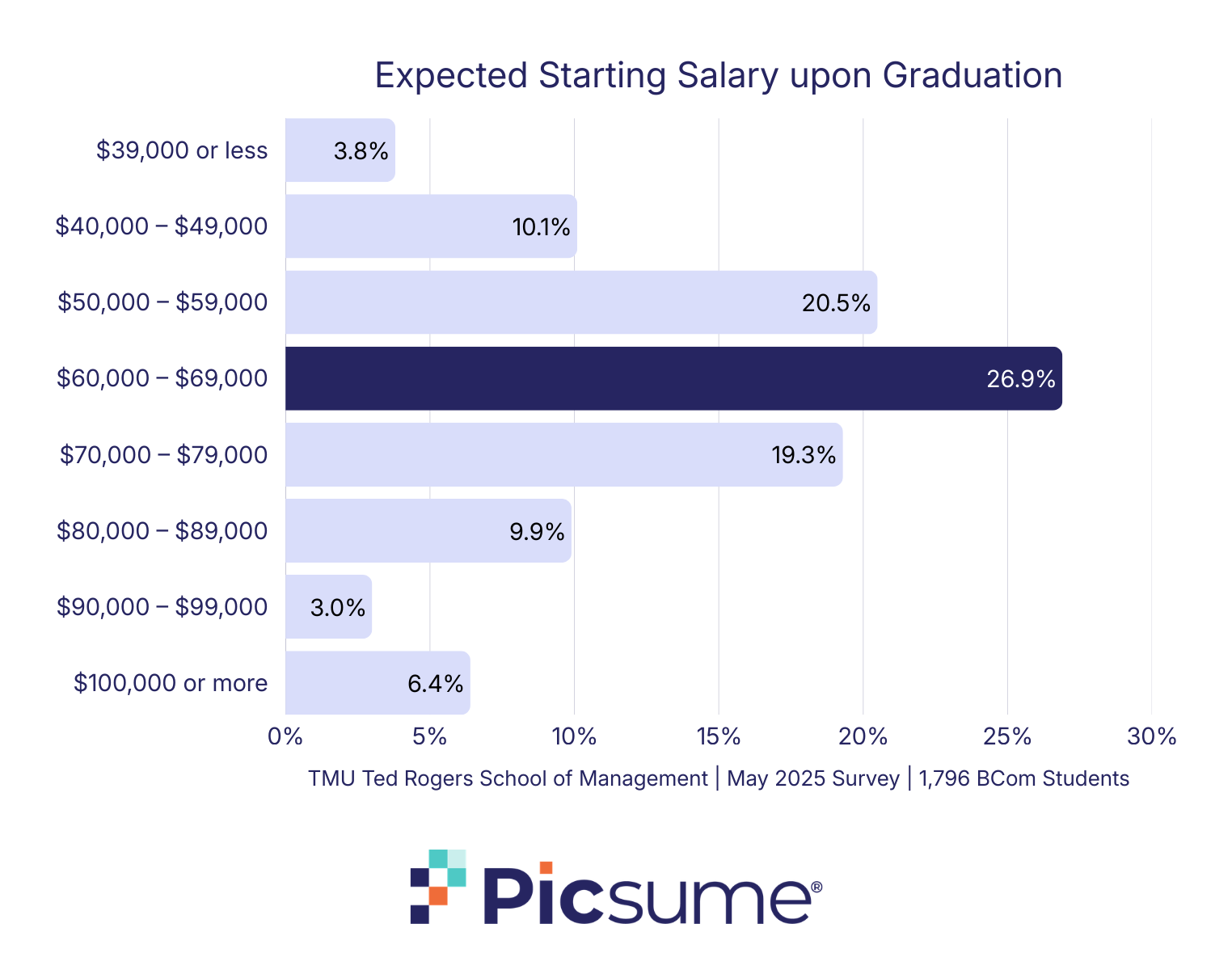
The most common expectation — by a clear margin — was $60,000–$69,000. Nearly half of all students (46.2%) expected to land somewhere between $60K and $79K. On the surface, that sounds reasonable. But let's hold it up against the data.
The Reality: What Statistics Canada Actually Shows
This is the part worth paying attention to. According to Statistics Canada's National Graduates Survey, the median income for full-time employed bachelor's degree graduates from the class of 2020 was $62,300 — measured three years after graduation, in 2023 dollars.
Read that again: three years after graduation, among those already working full-time.
For a student walking out the door for the first time? The honest picture looks more like this:
- Statistics Canada data shows that young workers aged 15–24 earn an average of $21.88/hour (men) and $20.58/hour (women) — which translates to roughly $40,000–$45,000 annually for someone entering the labour market.
- Earlier cohort data from Statistics Canada found that the median employment income two years after graduation for undergraduate degree holders was around $43,600–$50,900 depending on the graduating class and field — and that's two years in, not day one.
- The $62,300 milestone is real — but it's where most grads arrive after several years of full-time work, not where they start.
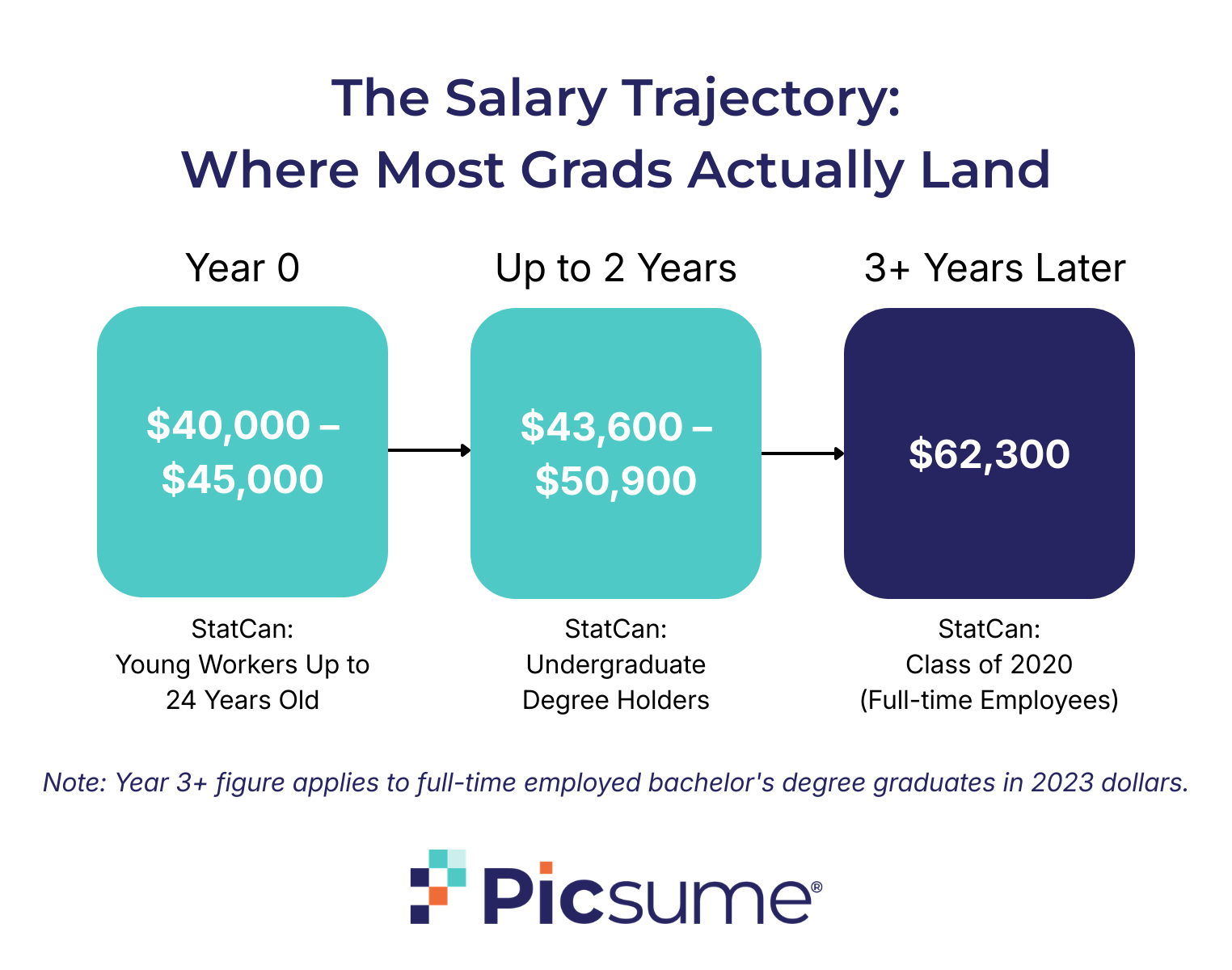
The gap, in plain terms: The most common student expectation (~$65,000) overshoots what new grads typically earn in their first year by as much as $20,000–$25,000. That's not a small rounding error — it's the difference between feeling blindsided by your first offer and being prepared to make smart decisions around it.
It Depends on Your Program (A Lot)
Here's where it gets more specific — and more useful. The TMU business school data breaks down salary expectations by individual programs, and the differences are telling.
Bottom line by program:
- BTM students are probably the most well-calibrated — tech and systems-adjacent roles genuinely pay more at entry level.
- Accounting & Finance students are close, but should factor in that the higher end of their expected range often requires a CPA designation or a couple of years of experience.
- Business Management students have appropriately modest expectations that reflect the generalist nature of the degree.
- HTM students may be slightly underselling themselves in some markets but are reading the entry-level reality correctly overall.
You're Not Wrong — You're Just Early
Here's the genuinely reassuring part of all this data: the $60–69K expectation isn't delusional. It's just not a starting point for most grads — it's a two-to-three year milestone.
Statistics Canada's cohort tracking consistently shows that degree-holders see meaningful income growth in the years right after graduation. The grads who close the gap fastest tend to share a few things in common:
They had co-op or internship experience. The TMU data shows co-op students cluster their salary expectations in the $60–79K range, while non-co-op students show a much wider spread — more expecting both very low and very high salaries. Co-op experience doesn't just look good on a resume; it gives you an accurate mental model of what roles actually pay and what employers actually value.
They knew what they were worth before negotiating. The single most common mistake new grads make in salary negotiations is anchoring too low because they're grateful to have an offer. Understanding the realistic range for your program and role — and knowing the trajectory — means you can negotiate from a position of clarity, not anxiety.
They had a resume that reflected specialized skills, not just a degree. In a market where a bachelor's degree is increasingly a baseline credential, the grads who earn at the top of the range in year one tend to be the ones who can demonstrate specific technical, analytical, or domain skills beyond the degree itself.
How to Close the Gap Faster
If you want to arrive at your target salary sooner rather than later, here's where to focus your energy:
- Specialize where you can. Generalist business degrees are valuable but common. Any specialization — whether it's data tools, financial modelling, a specific industry, or a certification — signals to employers that you're worth more.
- Turn your resume into a profile that works as hard as you do. Most hiring managers spend less than 10 seconds on a first scan. Your resume needs to surface your most relevant skills immediately — especially any quantifiable results from co-op, internships, or projects. Try leveling up to a Picsume dynamic work profile for better emphasis.
- Research the realistic range before every application. Use tools like Statistics Canada, Glassdoor, and job postings with listed salary bands to calibrate your expectations per role, not just per degree.
- Don't confuse "underpaid first job" with "underpaid forever." Year one rarely reflects your ceiling. It reflects your starting leverage. The grads who close the gap fastest are the ones who treat their first role as a data point, not a life sentence.
Frequently Asked Questions
Is $60,000 a realistic starting salary for a Canadian grad? It's achievable in higher-paying BCom programs like BTM, or for grads with strong co-op experience in major cities — but it's well above what most new grads earn in year one. Statistics Canada data points to a first-year reality closer to $40,000–$45,000 for young workers entering the market, with cohort data showing median incomes of $43,600–$50,900 two years after graduation. The $60K+ range is more typical after 2–3 years of full-time experience.
Does co-op really make a difference in starting salary? Yes — the data is clear on this. Co-op students not only form more realistic salary expectations, they enter the job market with a network, references, and demonstrated experience that gives them a competitive edge in both landing offers and negotiating salaries.
What if my first salary offer is lower than I expected? Take a breath — and know that this is normal. Statistics Canada data shows most young degree-holders start in the $40,000–$45,000 range, with meaningful growth in years two and three. A $45,000 role at a company with strong growth and promotion culture can easily become $60,000+ in two to three years. The title and trajectory sometimes matter more than the year-one number.
Should I negotiate my first job offer? You can, but do your research to determine whether you should. Ultimately, your objective is to get your foot in the door, and that requires treading carefully. Know the realistic market range for your program, role, and city. Come in with a specific, data-backed ask rather than a general "I was hoping for more." Employers expect negotiation; being prepared signals professionalism, not entitlement. The important part is to determine the right time and place for it.
At Picsume, we help Canadian graduates put their best foot forward with live dynamic work profiles that go beyond a resume to actually get noticed. Because your first salary starts with your first impression — and that starts with how well you present what you've built.